


Hawaii drivers are feeling the sting at the pump as gas prices continue to climb, driven by tensions in the Middle East, disruptions in oil production, and rising crude oil costs, according to the AAA Hawaii Weekend Gas Watch.
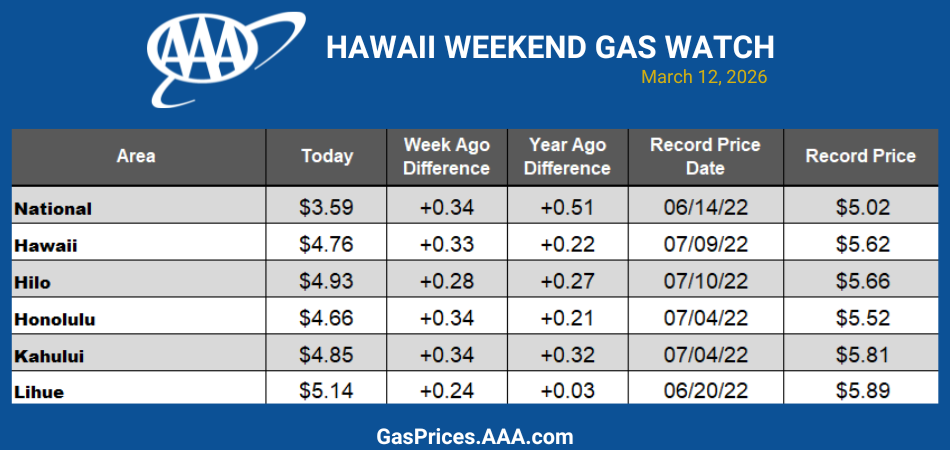
The statewide average for regular unleaded is $4.76 per gallon, up 33 cents from last week and 22 cents higher than a year ago. By comparison, the national average is $3.59 per gallon, up 34 cents from last week and 51 cents above last year.
In Honolulu, the average for regular unleaded is $4.66, up 34 cents from last week and 21 cents higher than last year. Hilo drivers are paying $4.93 per gallon, an increase of 28 cents from last week and 27 cents above last year. Kahului averages $4.85, up 34 cents from last week and 32 cents higher than last year, while in Lihue, the average is $5.14 per gallon, up 24 cents from last week and three cents higher than last year.
Gas prices are climbing nationwide, with Hawaii continuing to rank among the highest in the country. Several factors make the state’s gas more expensive than most other states. Hawaii does not produce its own crude oil and relies on imports from other countries.
Markets are also reacting to the ongoing conflict in Iran, with crude oil prices being a major factor. About 60% of what drivers pay at the pump is tied directly to the cost of crude oil, which is now near its highest levels in nearly two years. Since September 2024, U.S. crude oil prices have mostly traded between the upper $50s and mid-$70s per barrel. Recently, prices have spiked, with West Texas Intermediate (WTI) crude currently trading at about $90 per barrel, and at one point exceeding $100 per barrel. Higher crude oil prices often translate into higher gas prices, with every $1 increase in crude oil typically adding about 2 cents per gallon at the pump.
“AAA does not speculate on or forecast gas prices, especially because of geopolitical tensions and unexpected international events,” said Kandace Redd, AAA Hawaii spokesperson. “Gas prices ultimately depend on global supply, demand, refinery operations, and consumer behavior. All of those factors are constantly shifting. We recommend that drivers pay attention to price changes at the pump, plan ahead, and remember that unless premium fuel is recommended or required by your car’s manufacturer, it provides no added benefit.”
The Weekend Gas Watch monitors the average price of gasoline. As of 9 a.m. on March 12, averages are:
The Auto Club recommends these tips for drivers to save money on fuel:
- Optimize your fuel economy with steady speeds, no hard braking, and no “jackrabbit starts.”
- Don't haul extra weight in the passenger compartment or trunk, which reduces fuel economy.
- Properly maintain your vehicle and keep tires properly inflated according to the pressure listed in your owner’s manual, which will optimize fuel economy.
- Use the recommended fuel for your vehicle, and don’t use mid-grade or premium unless it is specifically recommended in your owner’s manual. AAA research shows the higher-grade fuel offers no extra benefit for vehicles that aren’t required to use it.
- Look into discounts. AAA members who sign up for the Shell Fuel Rewards Program at AAA.com/Shell can save 30 cents a gallon on their first fill-up, and five cents a gallon on all other fill-ups. Other retailers such as grocery stores also offer fuel discount programs, and some credit cards offer gas discounts.
- If your household has more than one vehicle, use the most fuel-efficient one as much as possible.
- Consolidate errands to reduce mileage and avoid driving during peak hours when traffic congestion will reduce your fuel efficiency.